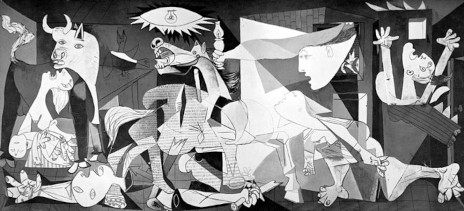
Art sometimes seeks beauty. Sometimes, it seeks truth. But rarely does it reject beauty altogether to confront us with truth in its rawest, most unfiltered form. Guernica is precisely that kind of work. Created in 1937 by Pablo Picasso, this monumental painting is not merely an anti-war statement—it is a brutal mirror held up to the darkest side of humanity.
To understand Guernica, we must first look at the moment of its birth. In 1937, during the Spanish Civil War, the small Basque town of Guernica was bombed by Nazi German aircraft. This was not an attack on a military target—it was a direct assault on civilians. Women, children, animals… the very heart of a town was torn apart by fire falling from the sky.
When Picasso learned of the atrocity, he seemed to recognize that art could no longer remain a purely aesthetic pursuit. The result was a visual nightmare rendered entirely in black, white, and grey. There is no color—because there is no life. No warmth. No hope.

At the center of the composition, a wounded horse writhes in agony, its mouth open in what appears to be a scream—yet no sound escapes. This silence is one of the painting’s most powerful elements. Nothing in Guernica is truly “heard”; everything is felt. Nearby lies a dismembered soldier, clutching a broken sword. It is a devastating rejection of heroic war narratives. There is no glory here—only ruin.
In another corner, a mother holds her dead child, her face lifted upward in a silent cry. This figure is among the most haunting images in art history. Her mouth is open, her grief absolute—and yet, again, we hear nothing. Guernica is a painting of a scream that will never be voiced, but can never be forgotten.
Picasso’s distorted forms and fractured bodies are not merely stylistic choices rooted in Cubism. They reflect the fragmentation of humanity itself. Reality is no longer whole; war has shattered it.
Editor’s Note:
The power of Guernica lies not only in what it shows, but also in what it refuses to explain. Picasso offers no clear narrative, no comforting structure. Instead, he throws us into chaos. Perhaps this is why Guernica cannot truly be “understood”—it can only be experienced.
Another striking element is the light source. The harsh electric bulb hanging above feels cold, mechanical—almost indifferent. It does not illuminate truth; it exposes tragedy. It suggests a modern world in which technological progress has made destruction more efficient, more systematic.

Guernica remains profoundly relevant today. Because war still exists. And civilians still pay the highest price. This painting does not belong to a single moment in history—it belongs to all of them. It transcends being merely an artwork and becomes something greater: a warning, a memory, a conscience.
Editor’s Note:
There are many powerful works in art history, but very few are as political, universal, and timeless as Guernica. It does not comfort the viewer—it disturbs them. And perhaps that is one of art’s most essential roles: to unsettle us, to force us out of complacency, and to make us confront reality.
Ultimately, Guernica is not just a painting—it is a stance. In Picasso’s hands, the brush becomes a weapon—not to destroy, but to remind. And every time we look at it, we hear that silent scream once more.



Leave a Reply