You wake up.
Before your thoughts fully form, your hand reaches for your phone.
You scroll, you read, you consume. Somewhere in that invisible flow of information, an algorithm has already predicted what you want to see.
And maybe, without realizing it, a question quietly emerges:
If machines can learn, write, predict, and even imitate us… do they have limits?
Or more unsettling:
Do we?
At first glance, the answer seems obvious. Of course artificial intelligence has limits. It makes mistakes. It hallucinates. It misunderstands context. It cannot fully replicate human thinking. These flaws are often presented as evidence that AI will always remain “less than human.”
But this perspective is shallow—because most of these are not true limits. They are delays.
Technology evolves. Models improve. Errors shrink. What feels like a boundary today often becomes irrelevant tomorrow. The history of technology is, in many ways, a history of broken limits.
So if not here, then where do the real limits lie?
The deeper boundary is not technical—it is existential.
Artificial intelligence can process meaning, but it does not experience it. It can analyze a poem, explain its metaphors, even mimic emotional language. But it has never felt loss. It has never waited for a message that never came. It has never stood in silence after something irreversible.
There is a difference between recognizing a pattern and living through it.
And that difference is everything.
Editor’s Reflection:
We often overestimate intelligence as computation. But human intelligence is inseparable from experience. We do not just understand the world—we undergo it.
AI does not.
This leads us to another boundary: the absence of a self.
Artificial intelligence has no inner life. It does not hesitate, doubt, or desire. It does not carry memories the way we do—heavy, distorted, emotional. It does not reinterpret its past to survive its present. It does not fear its future.
It responds, but it does not exist.
And yet, despite all this, there is an irony we rarely confront.
The most powerful limitation of artificial intelligence may not belong to the machine at all.
It belongs to us.
AI learns from human data. It reflects human language, human biases, human creativity, and human blind spots. It does not emerge from a vacuum—it emerges from us.
Which means:
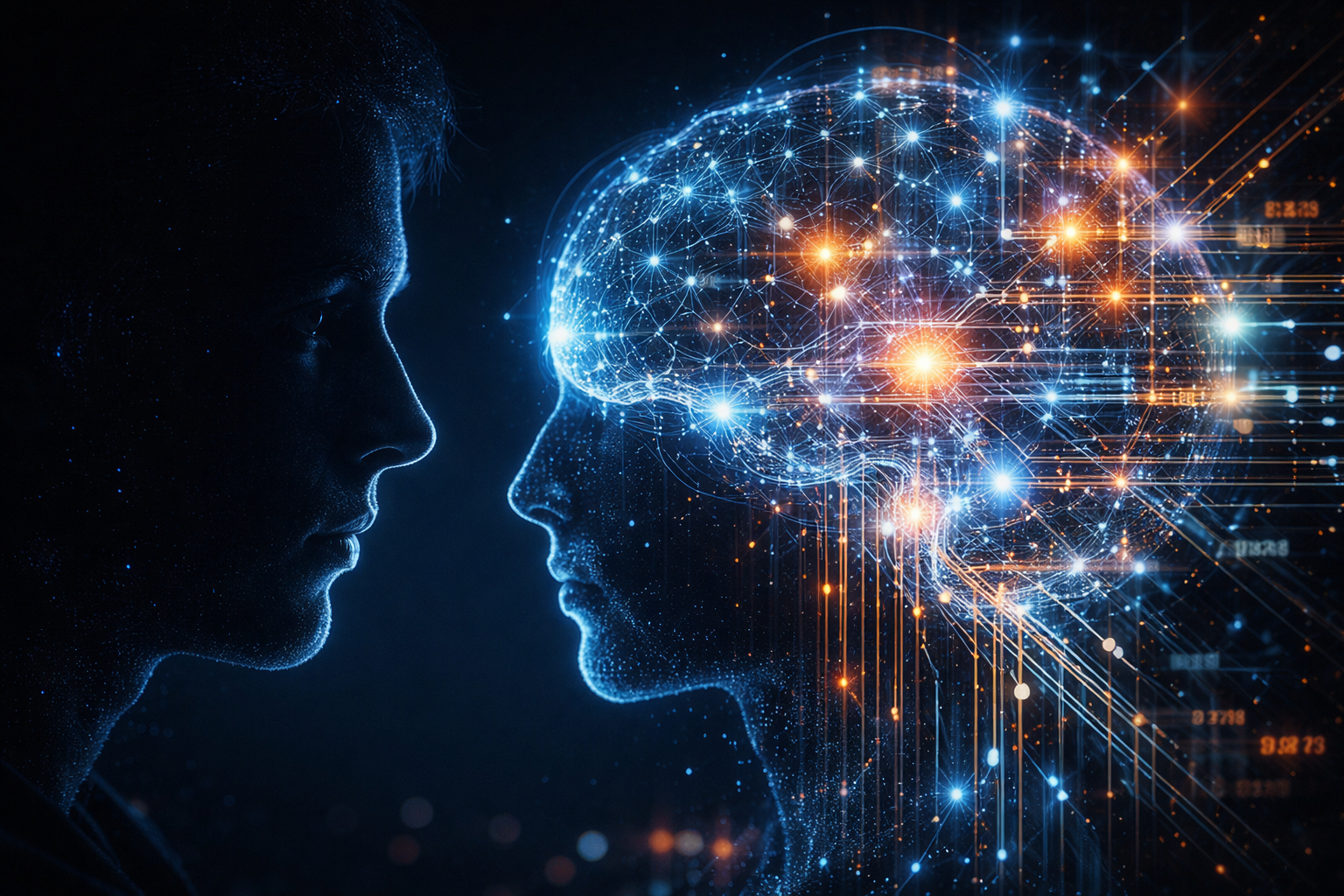
Its intelligence is, in some sense, a mirror.
Editor’s Reflection:
When we ask what AI can or cannot do, we are often asking the wrong question. A more uncomfortable question would be: What are we projecting into it?
Perhaps the real boundary is not whether AI can become like us.
But whether we are ready to confront what that resemblance reveals.
Because if a machine can replicate our words, our ideas, even our emotions—then what makes those things uniquely ours?
This is where the conversation shifts from technology to identity.
Artificial intelligence does not need to “replace” humans to challenge them. It only needs to reflect them closely enough.
And maybe that is already happening.
So, does AI have limits?
Yes.
But not where we feel most comfortable placing them.
Its limits are not just in code, data, or computation.
They are in meaning without experience, in intelligence without consciousness, in language without a life behind it.
And beyond all that—its greatest limit may be the one we bring to it.
Because in the end, artificial intelligence does not just force us to rethink machines.
It forces us to rethink what it means to be human.



Leave a Reply